Claim
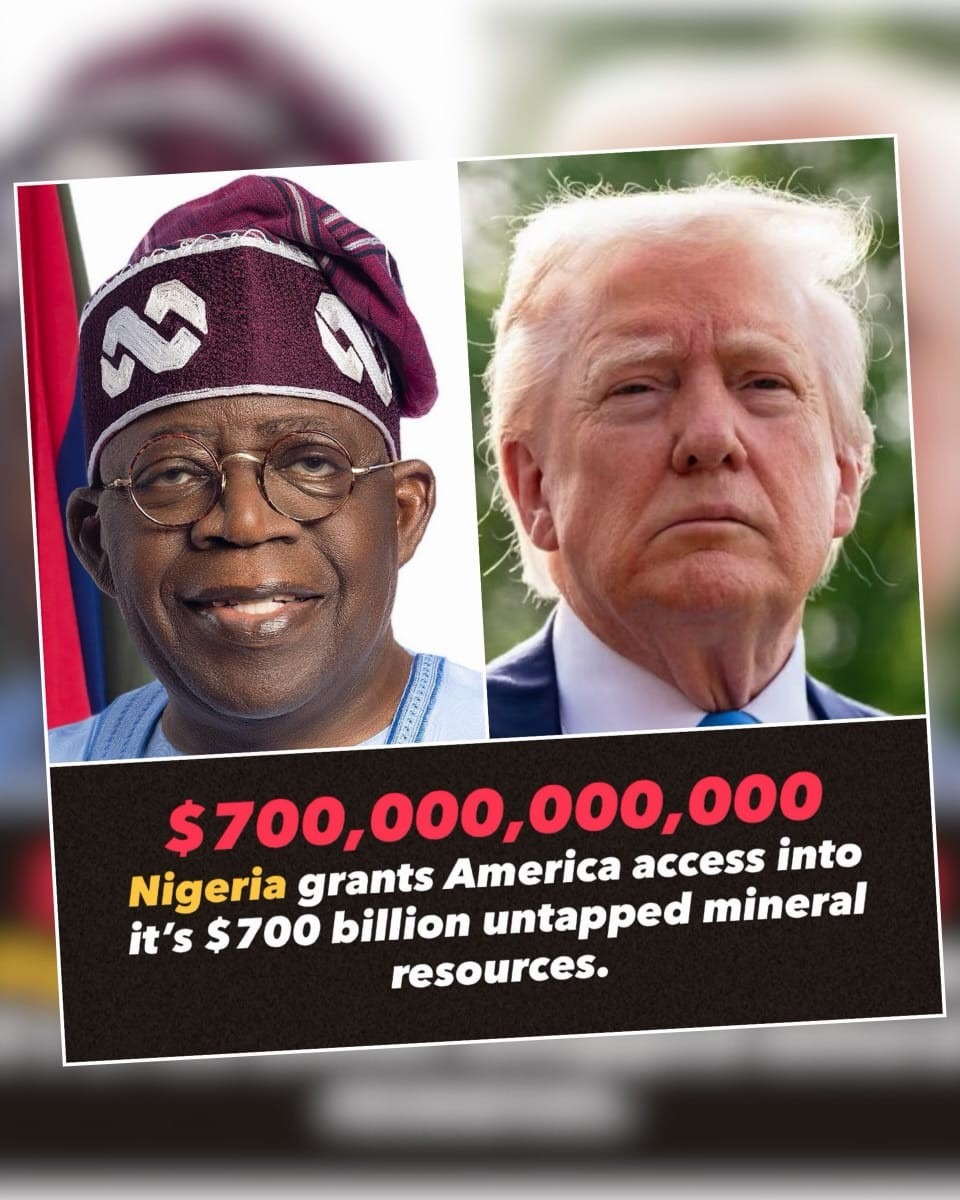
An Instagram image features a graphic of Nigerian President Bola Ahmed Tinubu and US President Donald Trump with the headline: “$700,000,000,000, Nigeria grants America access into its $700 billion untapped mineral resources.

Why We Checked
The post circulated heavily on Instagram, capturing significant public attention. Given the immense geopolitical implications, the economic valuation of Nigeria’s solid minerals, and public concern over national resource sovereignty, HaltFake verified the details to assess its accuracy.
As of the time of filing this fact-check, the content has garnered 16.7k likes, 5.5k comments and 870 reposts. This prompted the verification.
What We Found
A verification of official government communications and international press records reveals that while a landmark mining agreement was signed between Nigeria and the United States, the headline’s framing is misleading, regarding who signed it and what “granting access” actually means.
Based on the official report from the Federal Ministry of Information and National Orientation, the agreement is formally referred to as a “framework for American investment”, but the leaders pictured did not sign it.
On Wednesday, September 23, 2026, on the sidelines of the 81st United Nations General Assembly (UNGA) in New York, the pact was formalised by Nigeria’s Minister of Solid Minerals Development, Dele Alake, and the US Deputy Secretary of State, Christopher Landau, at the Nigeria Mission House.

International financial reporting confirms that the pact is not a blank check for foreign exploitation, but an investment gateway to unlock Nigeria’s massive solid mineral portfolio, which the Nigerian government valued at roughly $700 billion (€796 billion).
While the West African nation boasts vast reserves of lithium, gold, tin, gemstones, iron ore, and phosphate, it has historically exported raw ore to be refined overseas.
According to Deutsche Welle (DW), this bilateral framework explicitly aims to upend that dynamic by focusing on technical capacity, infrastructural development, and geological exploration to onshore the refining process.
The ultimate goal is to generate domestic jobs and scale business opportunities within Nigeria rather than leaving it as a mere source of raw materials for foreign economies.
Crucially, the agreement functions as a strategic, bilateral cooperation framework explicitly designed to channel and deepen American commercial investments directly into the West African country’s critical mining sector (0:00).
Rather than allowing unmonitored raw resource extraction, Nigeria’s Minister for Solid Minerals Development, Dele Alake, strongly emphasised that the core priority of this pact is to advance beyond the low-value export of raw materials (0:07). According to the Africanews Youtube video, the framework sets strict operational rules that require foreign investments to foster comprehensive local processing (0:28).
By establishing regional refining facilities within Nigeria, the deal aims to mandate local value addition, cultivate stronger technical skills, and secure quality jobs alongside greater economic opportunities for domestic businesses (0:21).
Former lawmaker Senator Shehu Sani weighed in on the exact claim, according to Daily Trust, commending the milestone but cautioning that agreements involving national sovereignty must be made public early for parliamentary scrutiny. Sani further noted that the deal must protect local host communities from exploitation and security threats rather than merely acting as an arrangement to swap out existing Chinese mining interests.
Reports published by major financial and international media outlets, including Reuters, Deutsche Welle (DW), and Nigeria’s ThisDay Newspaper, corroborate that the deal establishes an investment gateway rather than unmonitored access to national assets.
Verdict
Misleading.
The claim is misleadingly framed. While a historic mineral cooperation framework was signed in September 2026 to boost American investments in Nigeria’s solid minerals sector, it was signed by ministerial delegates rather than Trump and Tinubu directly.
Furthermore, it does not hand over unchecked control of resources; the agreement outlines terms for joint geological exploration and strictly mandates local value addition and processing to ensure Nigeria retains economic control over its estimated $700 billion mineral portfolio.