Claim
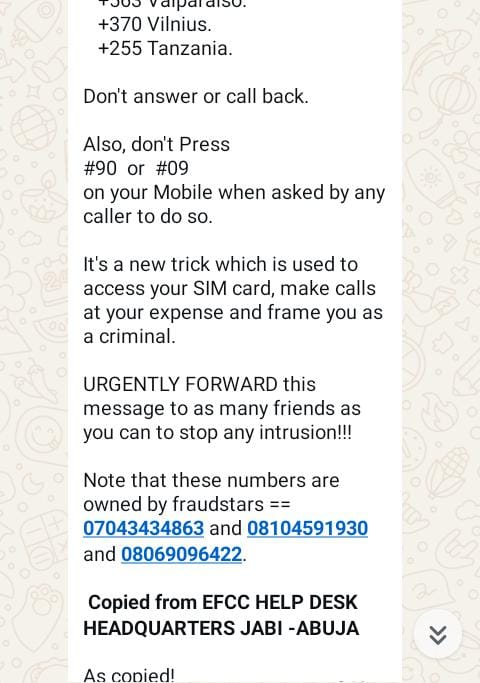
A viral WhatsApp broadcast circulating under the header “FROM EFCC DESK” warns the public against answering or calling back specific international phone numbers from countries like Belarus (+375), Latvia (+371), and Serbia (+381).
The message asserts that calling these numbers back allows fraudsters to copy your contact lists and banking details from your phone within three seconds. It also claims that pressing #90 or #09 allows hackers to clone your SIM card to make calls at your expense.
The message signs off as coming from the “EFCC HELP DESK HEADQUARTERS JABI – ABUJA.


Why We Checked
This broadcast contains highly technical claims that blend real telephone phenomena with extreme exaggerations, designed to spread panic across Nigerian community networks.
Furthermore, it explicitly attaches the name of the Economic and Financial Crimes Commission (EFCC) to gain false authority. Because misinformation attributed to a federal law enforcement agency can misdirect citizens away from actual, real-world security protocols, we conducted this verification to clear the air.
Verification
Our investigation deconstructed the message into three key elements:
The EFCC Attribution: We cross-referenced the claim against official registries of the anti-graft agency.
The EFCC has formally issued public disclaimers explicitly stating that it does not operate any unit called the
“EFCC Help Desk Headquarters” and has never authorized this viral broadcast.
The commission warned that authors utilizing their name for these automated alerts are doing so with “sinister motives.
“The “Three-Second” Data Theft Myth:
From a cybersecurity standpoint, simply placing a voice call to an international number cannot remotely access, copy, or download files, contact list data, or encrypted mobile banking applications from a modern smartphone.
For data theft to occur, a user must actively click a malicious link, download an infected payload, or surrender their financial passwords manually.
The True Element
(The Wangiri Scam): While the threat of data theft is fake, the mentioned numbers do belong to a globally recognized phone fraud tactic known as the “Wangiri” or “One-Ring” scam. Automated dialers call thousands of users and disconnect after a single ring.
The actual financial trap occurs if you call them back; you are unknowingly routed to premium-rate international toll numbers that rack up massive, expensive phone credit bills on your network provider line.
The #90 and #09 SIM Cloning Rumor:
This is an obsolete internet hoax that dates back decades. Pressing numbers on your keypad during a standard cellular voice call cannot clone your physical SIM card or allow external individuals to seize structural control of your phone operating network.
Verdict
MISLEADING WITH FALSE ATTRIBUTION.
The warning contains a grain of truth regarding the existence of international one-ring phone fraud (the Wangiri scam), but the EFCC never issued this statement.
The technical claims that hackers can siphon your contact lists or steal banking apps in three seconds merely by you calling a regular phone line are entirely false and scientifically impossible.
Conclusion
Members of the public are advised to stop forwarding this chain message. While you should absolutely avoid calling back unfamiliar international numbers to prevent your mobile call credit from being rapidly consumed, there is no risk of software-level hacking or contact siphoning via a basic voice phone call.
Official updates from the EFCC should only be trusted when verified on their official digital domains or through verified corporate media broadcasts.